Module 10
Aerospace Standards, ESD, and Workmanship
What you’ll be able to do
Recognize the boundary between self-study, controlled workmanship and release authority.
Course plan & prerequisites · Scope and sources · Revision 2026-09-10
On this page
Study an annotated diagram
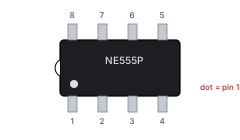
Black rectangular body with two rows of leads through the board; the notch (or molded dot) marks the pin-1 end, and pins number COUNTERCLOCKWISE from pin 1 when viewed from the top. Logic, op-amps, timers — often socketed on legacy aerospace cards. Failure modes: ESD damage, corroded socket contacts, bent or fatigued pins. DMM check: verify supply pins aren’t shorted to ground (resistance mode); functional faults need powered testing per the datasheet.
What separates aerospace CCA repair from hobby electronics isn't the circuits — it's the discipline around them. Boards you touch will fly. The standards below are the industry's accumulated answer to "what does it take for electronics to survive years of vibration, thermal cycling, and altitude, with lives attached." Treat this module as seriously as the technical ones; in interviews and on the floor, fluency here marks you as a professional.
1. The standards map (know what each one governs)
| Standard | Governs | What it means for you |
|---|---|---|
| IPC-A-610 | Acceptability of electronic assemblies | THE visual inspection bible: what a good/acceptable/defective solder joint, component placement, and board condition look like. The contract and controlled product documentation specify the applicable class, revision and addenda. Class 3 concerns high-performance/harsh-environment service; do not infer requirements from the word aerospace alone. |
| IPC J-STD-001 | Requirements for soldered assemblies (the process) | How soldering must be done — materials, methods, cleanliness. Has a Space and Military Applications addendum with extra requirements. A-610 judges the result; J-STD-001 governs the act. |
| IPC-7711/7721 | Rework (7711) and repair/modification (7721) | The procedures for everything you'll do: component removal/replacement, pad and trace repair, laminate repair, conformal coating removal and restoration. Each procedure has a number; aerospace shops require following them, not improvising. |
| IPC/WHMA-A-620 | Cable and wire harness assemblies | If your shop also touches harnesses/connectors. |
| ANSI/ESD S20.20 | ESD control programs | The framework behind your shop's wrist straps, mats, smocks, audits. |
| 9100 / 9110 family | Aerospace quality management | Applicable organization and contract determine the requirements; 9110 addresses maintenance organizations. Traceability, competence evidence and release authority remain controlled. |
Use the applicable acceptance requirement, not a memorized number. Class, revision, addenda, joint type and permitted exceptions affect inspection. This course does not reproduce normative solder-fill tables or qualify an inspector. Obtain the controlled standard and procedure for the job, record the exact criterion, and escalate a missing or conflicting requirement.
2. ESD discipline — the invisible killer
Static you can't feel (below ~3kV) destroys or wounds modern semiconductors; a wounded part passes test and fails in flight. The rules exist because the damage is invisible and latent:
- Use the task's verified ESD-control method. A wrist strap includes current-limiting resistance but is not electrical protective equipment. Follow the facility's electrical-safety restrictions for energized work; never substitute a plain wire. Check straps and workstation equipment at the frequency required by the ESD program.
- Work only at a protected workstation: dissipative mat, common-point ground, grounded soldering iron tip.
- ESD-protective smock over clothing; no synthetic fleece/charge generators at the bench; keep common plastics (tape dispensers, foam cups, bubble wrap) out of the ESD-protected area — insulators can't be grounded and field-zap parts at a distance.
- Boards travel in shielded bags or conductive totes, never in your bare hand across the shop, never set on random surfaces.
- Handle boards by the edges, away from connector pins and components.
- Humidity matters: dry air = higher static; winter is ESD season.
3. FOD — foreign object debris
A clipped lead, a solder ball, a screw left inside an LRU (line-replaceable unit) becomes a flying short circuit. Aerospace FOD discipline: account for every tool and consumable; clean as you go; clipped leads captured, not flicked; inspect work area before closing any assembly; report any unaccounted-for item immediately. (Tool control — shadow boards, tool check-in/out — exists for the same reason.)
4. Soldering & rework: the Class 3 mindset
You'll be trained formally (likely J-STD-001 certification); these are the principles to arrive knowing:
- Heat discipline: correct tip, correct temperature, minimum dwell. Excess heat lifts pads, delaminates laminate, cracks ceramic parts, and kills semiconductors. Adjacent MLCCs crack from nearby rework heat — preheat the board for significant rework rather than fighting thermal mass with a hotter iron.
- A good joint: wetted, smooth, concave fillet; outline of the lead visible; no cracks, voids at the surface, disturbed ("cold") texture, or insufficient fill. Study A-610 images until your eye is calibrated.
- Cleanliness: flux residues are removed per process (residues cause corrosion and leakage currents — see the analog "drift" failures in 08 — Analog Board Troubleshooting). No-clean vs water-soluble flux rules differ; follow the shop's process exactly.
- Wire/lead prep, strain, and bend radii are all specified — Class 3 inspects them.
- Tin whiskers: pure-tin finishes can grow conductive metal whiskers over years — a known aerospace hazard (lead-free/pure-tin parts are controlled or mitigated in many aerospace programs). Relevant to you two ways: a possible cause of mystery shorts on aged hardware, and a reason parts/finishes are specified strictly — never substitute a "same value" part with an unapproved finish.
- Moisture-sensitive devices (MSL): plastic IC packages absorb moisture; soldering a "wet" part can popcorn it internally. Parts live in dry storage/dry packs; respect floor-life clocks.
- One repair, by the book: IPC-7711/7721 procedures specify allowable repairs (e.g., how many pad repairs, trace repair methods with approved materials). Some damage exceeds repair limits → the board is dispositioned by Material Review, not heroically patched.
5. Conformal coating
Aerospace boards wear a clear protective coat (acrylic, urethane, silicone, parylene...) against humidity, condensation, and contamination at altitude.
- Diagnosis: coating blocks probes — use test points, connector pins, and vias left exposed; where you must penetrate, do it per approved procedure and log it.
- Rework: remove coating locally (solvent, thermal, mechanical, micro-abrasion — per coating type and per 7711/7721), do the repair, clean, then restore the coating with the approved material, cured per spec, inspected (often under UV — many coatings fluoresce).
- Coating type matters: silicone removal ≠ acrylic removal. The shop traveler/spec tells you which is on the board.
6. Traceability, documentation, and humility
- Every part has a pedigree. Replacement components come from controlled stock with lot/date codes recorded — never from a personal parts bin. Counterfeit parts are a real aerospace threat; the controlled supply chain is the defense.
- Every action is recorded: findings, measurements, parts replaced (with lot numbers), procedures used, your stamp/signature. The repair record outlives the repair.
- Revision control: boards have dash numbers and revisions; the applicable BOM, schematic and test procedure must agree for this revision; stop and obtain an approved disposition if they conflict. A "same" board at a different rev may legitimately differ.
- Calibrated instruments only: your DMM and scope carry cal stickers; out-of-cal instruments are unusable for acceptance measurements. Check the sticker date; report drops/damage.
- When in doubt, stop and ask. Aerospace culture rewards the tech who stops over the tech who guesses. An escape (a bad board shipped) is enormously more costly than a question. Nonconforming conditions you can't disposition go to MRB (Material Review Board) — that's the system working, not a failure.
7. Personal bench habits that mark a pro
- Use the verified ESD-control method required for the task. Wrist straps are not electrical protective equipment and may be prohibited for energized work by the electrical-safety procedure.
- Magnification for every inspection; lighting matters.
- Board handled by edges, supported during rework (flex cracks ceramics).
- Notes taken during, not after.
- Bench cleared between jobs (FOD + mixed-hardware errors).
- Torque, lockwire, and fastener rules followed where applicable to LRU assembly/disassembly.
- You never bypass a fixture, defeat an interlock, or "adjust" a limit to make a test pass.
8. Self-check
- What does IPC-A-610 Class 3 mean and why does aerospace use it? High-performance/harsh-environment service; applicability comes from controlled product requirements, not a blanket aerospace rule.
- A-610 vs J-STD-001 vs 7711/7721 — one phrase each. Acceptance criteria / soldering process requirements / rework & repair procedures
- Why is "latent" ESD damage worse than instant death? Wounded part passes test, fails in service — in flight
- You replace a cap and the board passes. What's still mandatory before it ships? Cleaning per process, conformal coat restoration, full retest, complete documentation with traceable part lot
- Why can't you grab an equivalent capacitor from a personal stash? Traceability/counterfeit control — uncontrolled parts void the pedigree of a flight article
You've reached the end of the curriculum
Return to CCA Repair Technician Training Program — Start Here for the 12-week drill plan, and keep the three visual HTML references within arm's reach. When you start the job: learn the shop's specific test specs, travelers, and tribal knowledge fast — the senior techs' Pareto wisdom for each assembly is the textbook nobody printed.
Worked example & practice
Example: A test limit from another board revision cannot establish acceptance. Hold for reconciliation rather than borrowing a generic tolerance.
Your turn: Complete the conflicting-documents drill and fill a practice traveler with the exact evidence needed for disposition.
Check: Can you identify the controlled procedure, applicable class/revision and authorized sign-off?
Open the annotated Component Gallery guide · Guided physical practice
Module quiz
10 questions drawn from this module. Pass is 80% — retake as often as you like; your best score is kept on this device.