Module 02
Reading Schematics
What you’ll be able to do
Turn a symptom into a traceable net, reference designator and test point.
Course plan & prerequisites · Scope and sources · Revision 2026-09-10
On this page
Study an annotated diagram
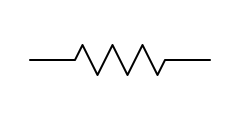
R
Limits current and drops voltage. On the bench: measure resistance in-circuit only with power off, and expect parallel paths to read low — lift one leg to be sure. Open resistors usually show a burn mark or read OL.A schematic is the board's source code. Repair work is constant translation between three documents: the schematic (what's connected to what), the assembly drawing / BOM (which physical part is which designator, and where it sits), and the board itself. Open visuals/01-schematic-symbols.html ↗ in a browser alongside this module — it has every symbol drawn and annotated.
1. The grammar of a schematic
- Symbols are the words (resistor, capacitor, transistor...). Learn them from the visual reference until recall is instant.
- Reference designators are the names: a letter for type plus a number — R47, C12, U3, Q8. The same designator is printed on the board's silkscreen — that's how you go from schematic to physical part.
- Values/part numbers sit next to each symbol:
R47 4.7k,C12 100nF 50V,U3 LM358. - Nets are the wires. Every point connected by lines (or by shared net name) is electrically one node — same voltage everywhere on it.
- Net labels connect without drawn wires. If
SPI_CLKappears in three places, those points are connected even across pages. This is how big schematics avoid spaghetti. - Junction dots: a dot where lines cross = connected. No dot = wires crossing without touching. (Old drawings sometimes used a "hop" arc for no-connect crossings.)
- Power symbols (
+5V,+3V3,VCC,+28V) and ground symbols are implicit global nets — every+5Vflag is the same net. Multiple different ground symbols (signal vs chassis vs analog) are different nets — joined only where deliberately shown.
Reference designator letters (memorize)
| Letter | Component | Letter | Component |
|---|---|---|---|
| R | Resistor | U | Integrated circuit |
| C | Capacitor | Y / X | Crystal / oscillator |
| L | Inductor | F | Fuse |
| D or CR | Diode (CR is common on military/aerospace drawings) | K | Relay |
| Q | Transistor | J / P | Jack (fixed) / Plug (mating) connector |
| T | Transformer | S / SW | Switch |
| TP | Test point | FB | Ferrite bead |
| VR / RV | Regulator or variable resistor / varistor (check the drawing's conventions) | BT | Battery |
2. Reading conventions that orient you fast
- Signal flow is left → right, voltage is high → low on the page (supplies at top, grounds at bottom). Not a law, but a strong convention.
- Inputs on the left of a symbol, outputs on the right.
- Grid coordinates (letters/numbers on the border) — multi-sheet schematics reference signals like "to SHEET 3, ZONE B2."
- A bar over a signal name (or a leading
/,#,n, or trailing*— e.g.RESET̄,/CS,WR#) means active-low: the signal does its job when at 0V. Critical for digital work — a held-low active-low reset means the processor is permanently in reset, a classic fault signature. - Bus notation: a thick line labeled
D[0..7]with a slash-8 is eight wires drawn as one. - No-connect: a small × or "NC" on a pin means deliberately unconnected.
- DNP / DNI ("do not populate/install") next to a part: it's on the schematic but intentionally absent from the board. Don't write up a "missing" DNP part as a defect.
3. Pin numbering on ICs
- DIP/SOIC/QFP: pin 1 is marked by a dot, notch, or beveled edge; numbering runs counterclockwise viewed from the top.
- The schematic symbol may scatter pins logically (all power pins grouped, etc.) rather than physically — always trust the pin numbers, not their drawn position.
- Power pins are often hidden on logic symbols of older drawings (implied VCC=14/GND=7 style). If you can't find an IC's power on the page, check the schematic's power-distribution sheet.
4. How to read a schematic you've never seen (the 10-minute survey)
- Find power entry. Locate the input connector, fuse, protection diodes, and every regulator. Write down the rail list: e.g. 28V in → 5V → 3.3V → 1.2V. This is your future troubleshooting map — most dead boards die in this chain.
- Find the brain. The biggest IC (processor/FPGA), its crystal/oscillator, and its reset circuit.
- Trace the signal path for the board's main function: input connector → conditioning → conversion/processing → output drivers → output connector.
- Inventory the test points. TPs are placed where designers expected someone to need a probe — they're a guided tour of the important nets.
- Note interfaces between sections — analog/digital boundaries, opto-isolators, transformers, level shifters. Faults often hide at boundaries.
5. From schematic to board and back
- Silkscreen designator → schematic: find R47 on the drawing, see what net it's on, see what should be at each end.
- ATE failure ticket → schematic: a Teradyne ticket names a designator and nets; the schematic tells you everything else touching those nets — your suspect list.
- No silkscreen visible (dense boards, conformal coat)? Use the assembly drawing, which maps every designator to an X-Y location.
6. Reading values
- Resistors:
4k7means 4.7kΩ (the letter replaces the decimal point — European/aerospace style).R047= 0.047Ω.0R= zero-ohm jumper. - Capacitors: assume µF for big numbers with electrolytics, nF/pF context for small.
104marking = 10 × 10⁴ pF = 100nF. Voltage rating matters: a 16V cap on a 28V rail is a design/assembly error and a fire. - Cross-check the applicable BOM, schematic and assembly revision. If they disagree, stop and obtain a controlled-document reconciliation or approved disposition; do not choose a value solely because one document has a newer date.
7. Drill (daily, week 2)
- Open the symbols HTML and quiz yourself: cover captions, name every symbol + designator letter.
- Sketch from memory: voltage divider, RC low-pass filter, LED + series resistor, NPN switching a relay coil (with flyback diode), 3-terminal regulator with input/output caps.
- Find a free schematic online (guitar pedal, Arduino, old radio service manual) and run the 10-minute survey on it. Write the rail list and the signal path in one paragraph.
Next: 03 — Component Identification & How Each Part Fails
Worked example & practice
Example: For an absent output, trace the source through the input connector, protection, regulator and load. A net label reconnects a signal across pages; a crossing without a junction does not.
Your turn: Use the annotated schematic below. Name the reference node and predict each supply-path test point before reading its explanation.
Check: Can another learner locate your measurement from your notes alone?
Open the annotated Schematic Symbols guide · Guided physical practice
Module quiz
10 questions drawn from this module. Pass is 80% — retake as often as you like; your best score is kept on this device.